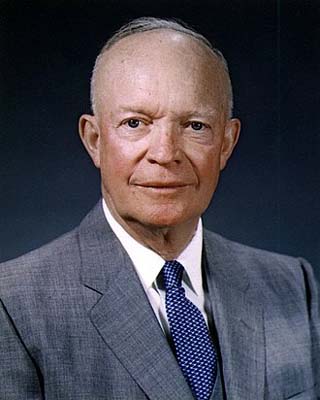
In 1952, Eisenhower entered the
presidential race as a Republican to block the isolationist
foreign policies of Senator Robert A. Taft, who opposed NATO.
Eisenhower won that year's election and the 1956 election in
landslides, both times defeating Adlai Stevenson II.
Eisenhower's main goals in office were to contain the spread
of communism and reduce federal deficits. In 1953, he
considered using nuclear weapons to end the Korean War and may
have threatened China with nuclear attack if an armistice was
not reached quickly. China did agree and an armistice
resulted, which remains in effect.
On the domestic
front, Eisenhower governed as a moderate conservative who
continued New Deal agencies and expanded Social Security. He
covertly opposed Joseph McCarthy and contributed to the end of
McCarthyism by openly invoking executive privilege.
He
signed the Civil Rights Act of 1957 and sent Army troops to
enforce federal court orders which integrated schools in
Little Rock, Arkansas. His administration undertook the
development and construction of the Interstate Highway System,
which remains the largest construction of roadways in American
history. In 1957, following the Soviet launch of Sputnik,
Eisenhower led the American response which included the
creation of NASA and the establishment of a stronger,
science-based education via the National Defense Education
Act.
|