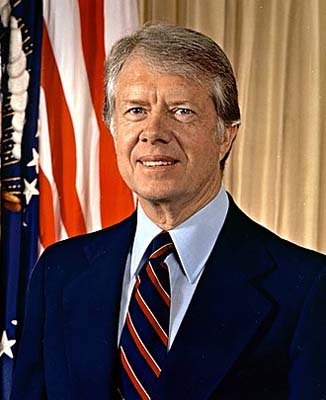
Carter pardoned all Vietnam War
draft evaders on his second day in office. He created a
national energy policy that included conservation, price
control, and new technology. Carter successfully pursued the
Camp David Accords, the Panama Canal Treaties, and the second
round of Strategic Arms Limitation Talks. He also confronted
stagflation. His administration established the U.S.
Department of Energy and the Department of Education.
The end of his presidency was marked by the Iran hostage
crisis, an energy crisis, the Three Mile Island accident, the
Nicaraguan Revolution, and the Soviet invasion of Afghanistan.
In response to the invasion, Carter escalated the Cold War by
ending détente, imposing a grain embargo against the Soviets,
enunciating the Carter Doctrine, and leading the multinational
boycott of the 1980 Summer Olympics in Moscow.
Carter
attempted to calm various conflicts around the world, most
visibly in the Middle East with the signing of the Camp David
Accords; giving back the Panama Canal to Panama; and signing
the SALT II nuclear arms reduction treaty with Soviet leader
Leonid Brezhnev.
.
|