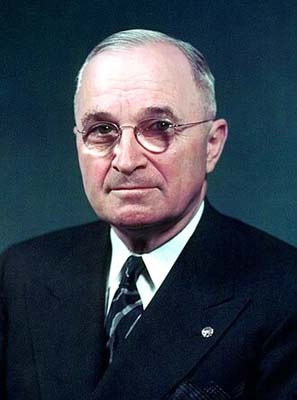
Harry S Truman was the 33rd
president of the United States, serving from 1945 to 1953. A
member of the Democratic Party, he previously served as a
United States senator from Missouri from 1935 to 1945 and
briefly as the 34th vice president in 1945 under Franklin D.
Roosevelt. Assuming the presidency after Roosevelt's death,
Truman implemented the Marshall Plan in the wake of World War
II to rebuild the economy of Western Europe and established
both the Truman Doctrine and NATO to contain the expansion of
Soviet communism. He proposed numerous liberal domestic
reforms, but few were enacted by the conservative coalition
that dominated the Congress.
Truman was elected vice
president in the 1944 presidential election and assumed the
presidency upon Roosevelt's death in April 1945. It was only
when Truman assumed the presidency that he was informed about
the ongoing Manhattan Project and the atomic bomb.
Truman authorized the first and only use of nuclear weapons in
war against the Japanese cities of Hiroshima and Nagasaki,
leading to Japan's surrender and the end of the world war.
Truman's administration engaged in an internationalist foreign
policy by working closely with Britain. Truman staunchly
denounced isolationism. He energized the New Deal coalition
during the 1948 presidential election, despite a divided
Democratic Party, and won a surprise victory against
Republican Party nominee Thomas E. Dewey that secured his own
presidential term.
|